Transforming industrial processes into Industrial Intelligence.
Industrial AI is transforming manufacturing - but only when it can be trusted. East Gate combines automation, integration, mobilization and deterministic execution with AI-driven intelligence for real industrial operations.
Industrial AI as an enabler of the Smart Factory
The primary objective of every manufacturing enterprise is to achieve operational excellence by continuously improving productivity, quality, flexibility and responsiveness.
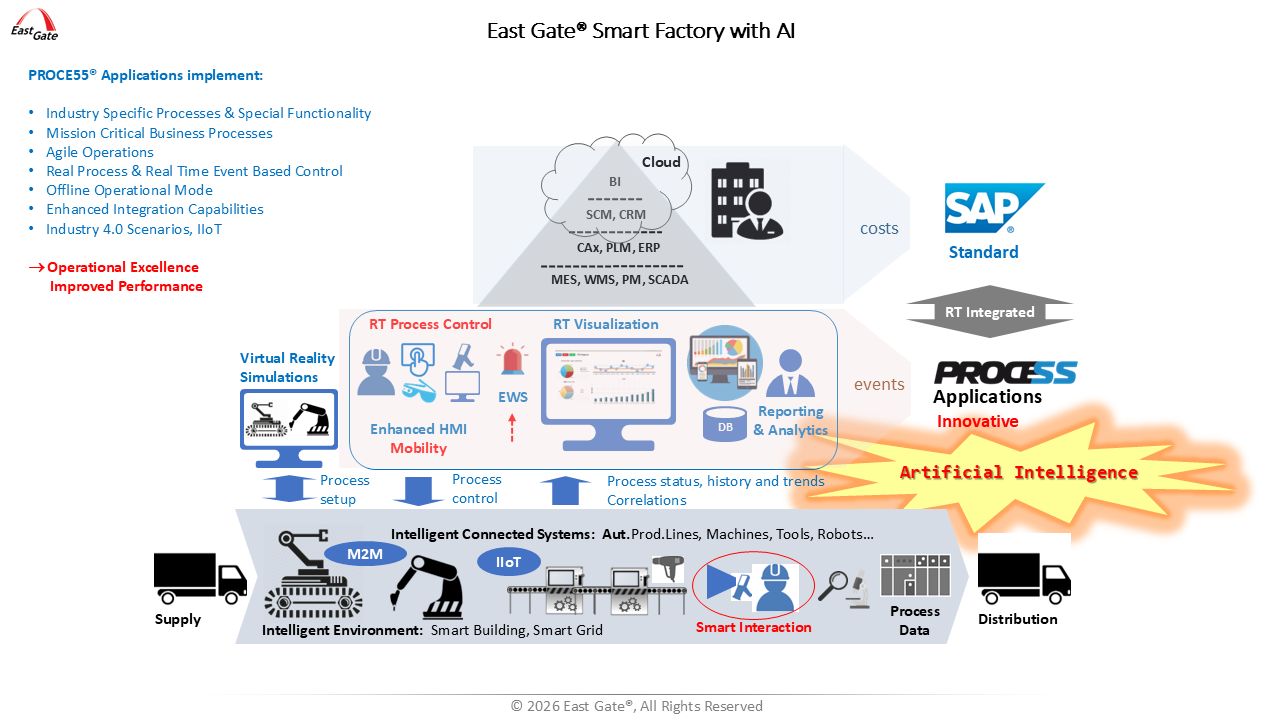
At East Gate, we believe that the most effective path toward this goal is the implementation of the Smart Factory and Industry 4.0 paradigm, where enterprise systems, production processes, machines and people work together as one intelligent ecosystem.
For more than two decades, East Gate has helped manufacturing companies transform their operations through automation, integration and mobilization of mission-critical business processes. Our PROCE55® platform enables rapid development of customer-specific applications that extend standard ERP systems and seamlessly connect enterprise information systems with real production environments.
A pragmatic evolution
- Standard ERP systems efficiently manage standardized business processes.
- Customer-specific applications provide the agility and specialization required for competitive advantage.
- Artificial Intelligence enhances these applications with cognitive capabilities while preserving deterministic and reliable business process execution.
Pragmatic Industrial AI for manufacturing
Artificial Intelligence is transforming manufacturing, but successful adoption requires more than deploying Large Language Models or introducing autonomous agents. Industrial AI must be practical, secure, modular and tightly integrated with existing industrial systems.
Digital Assistants
AI acts as an intelligent assistant between people and enterprise systems. Operators interact naturally using speech or text, while AI understands intent, retrieves information and guides users through business processes.
Autonomous Industrial Systems
AI enables machines, robots and autonomous devices to perform routine tasks with greater speed, consistency and precision, improving quality and overall equipment effectiveness.
Secure On-Premise AI
Industrial data remains under customer control. Whenever appropriate, compact task-specific AI models run within the customer's own IT infrastructure without exposing sensitive production data to public cloud services.
Modular Architecture
AI components such as speech recognition, language understanding, reasoning, predictive analytics and specialized services can be replaced or extended independently.
Deterministic AI
AI provides understanding, reasoning, predictions and recommendations - but mission-critical actions remain under the control of PROCE55®, which validates, orchestrates and executes every process in an auditable way.
Process-First Mindset
East Gate starts with the industrial process. AI is applied where it creates measurable value and where it can operate safely within clearly defined business and operational boundaries.
The framework for industrial-grade agentic systems
Agentic AI works well in soft environments where errors are reversible. Factories require something different: deterministic execution, strict process control, safety, traceability and integration with machines, ERP systems and people.
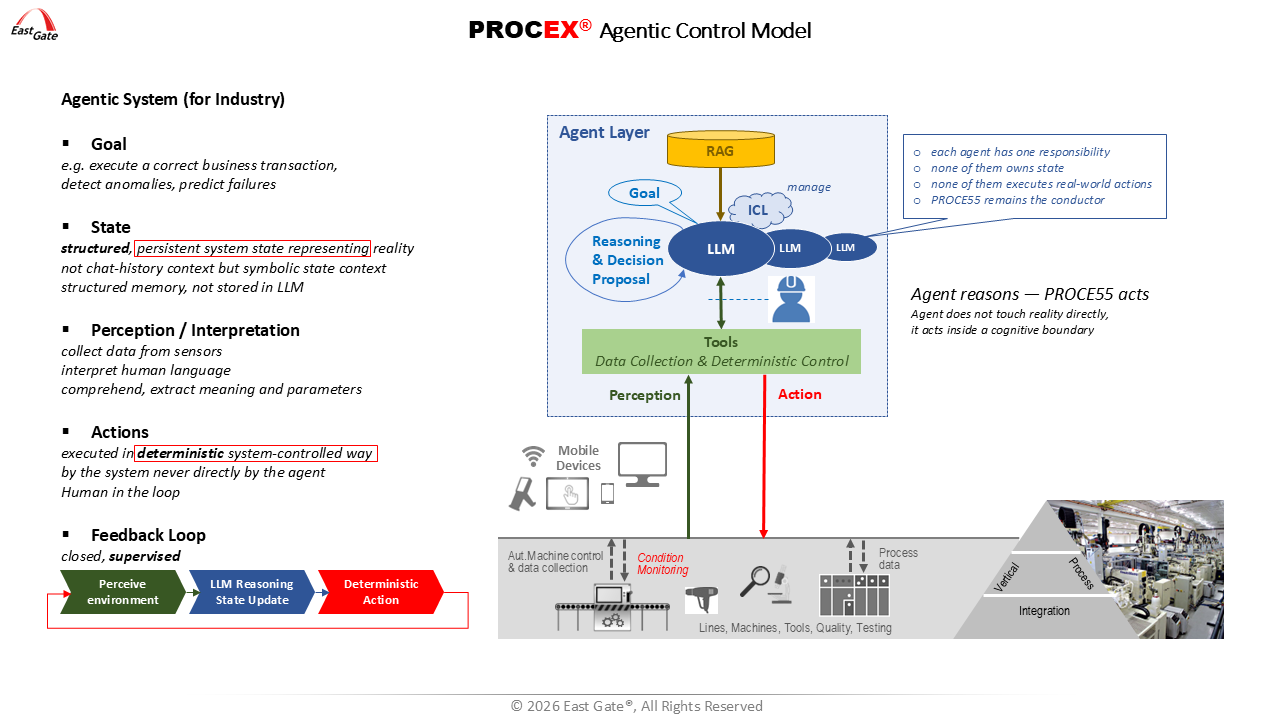
Agentic Control Model
Modern AI agents typically follow a simple loop: Perceive -> Reason -> Act. In industrial environments, this model alone is insufficient. Allowing an AI model to directly execute business transactions or control physical equipment introduces unacceptable operational risks.
PROCEX extends the traditional agent model by introducing a deterministic execution layer between reasoning and action. AI agents perceive information from operators, machines, sensors and enterprise systems. AI interprets context, understands intent, predicts outcomes and proposes optimal actions. The current operational state is maintained as a structured, persistent system model rather than as temporary conversational context.
Every proposed action is validated against explicit business rules, process constraints, Digital Twins or human approval. Only after successful validation does PROCE55® execute the corresponding business transaction or machine operation.
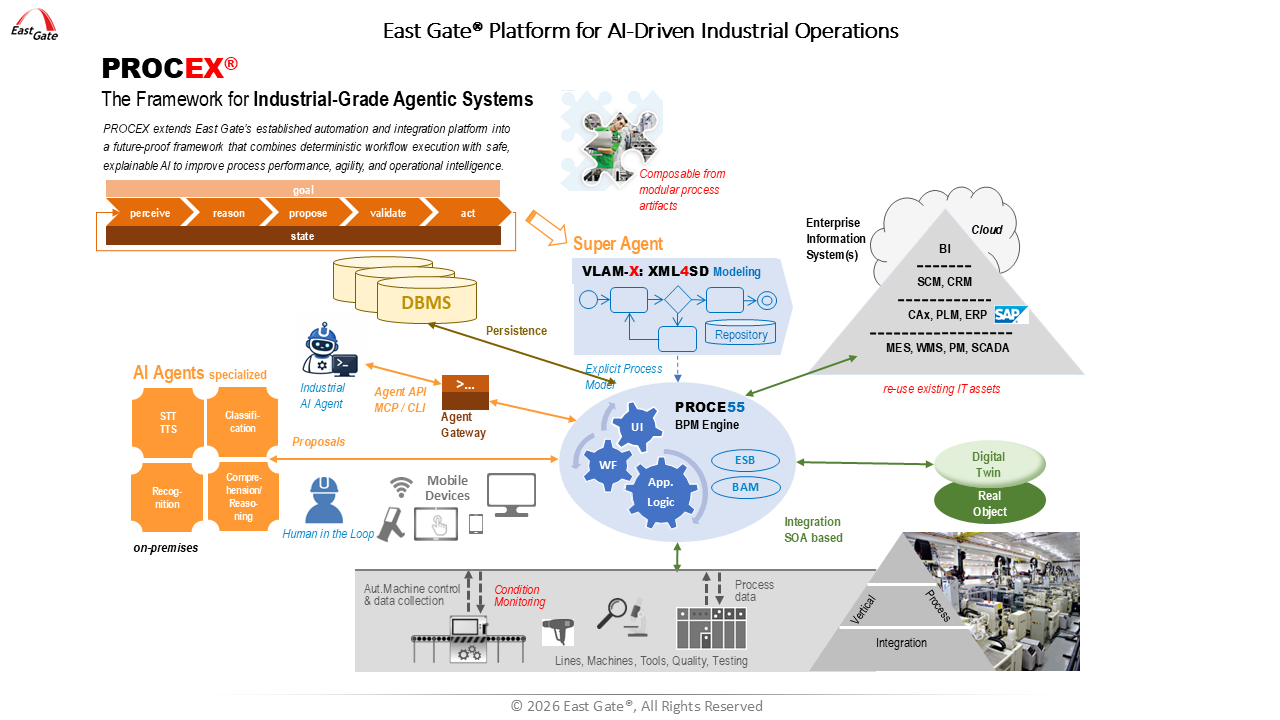
Platform Architecture
PROCEX builds upon East Gate's established PROCE55® automation platform and extends it into a comprehensive Industrial AI framework.
Intelligent Perception
Industrial AI agents collect and interpret information from operators, enterprise applications, sensors, production equipment and Digital Twins.
Cognitive Reasoning
Specialized AI components perform language understanding, speech processing, classification, prediction, optimization and reasoning.
Explicit Process Knowledge
PROCEX maintains an explicit model of business processes, operational state, workflow definitions, application logic and system constraints.
Deterministic Execution
Every business action is executed through the PROCE55® Business Process Engine for auditability, transparency and industrial-grade reliability.
Human-in-the-Loop
Mission-critical decisions remain under human supervision whenever required, with AI-generated recommendations presented in context.
Enterprise Integration
PROCEX extends ERP, MES, SCADA, WMS, PM and Industrial IoT environments with controllable AI capabilities.
AI Voice Assistant for SAP and Manufacturing
VoiceToTransaction (V2T) introduces a hands-free, AI-powered interface for executing business transactions on the shop floor.
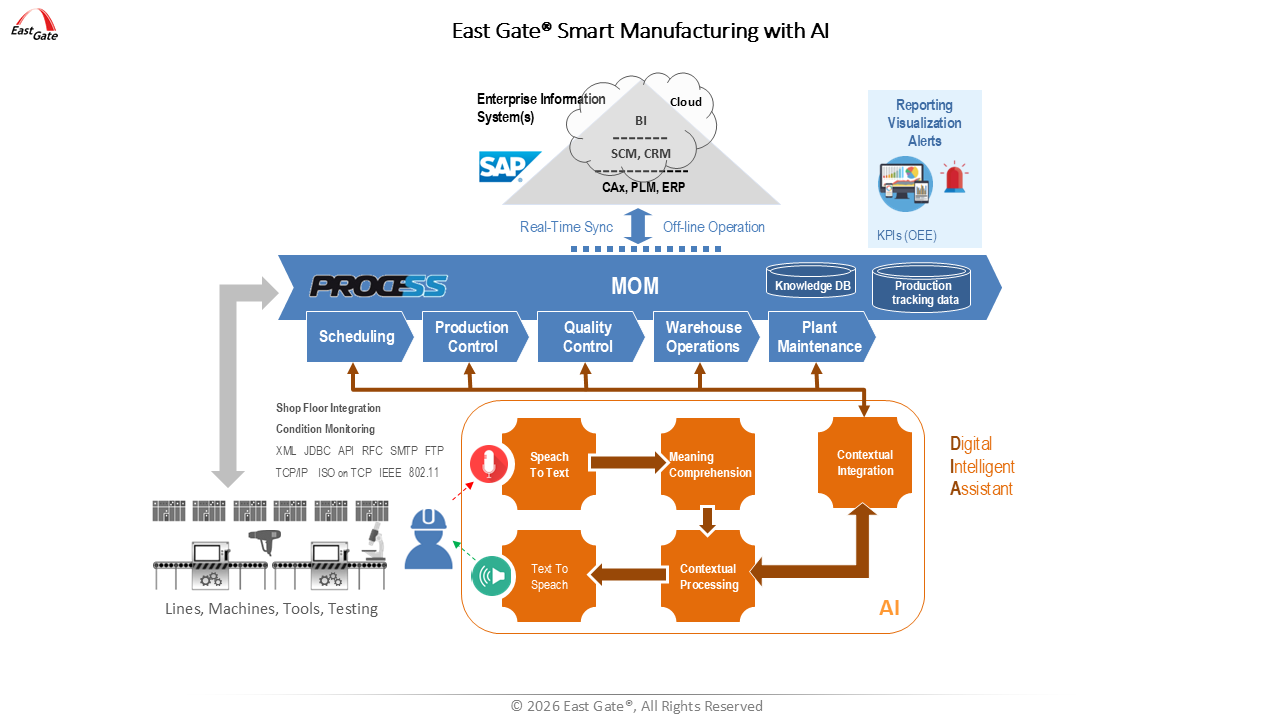
Natural language interaction for industrial operations
Digital transformation should simplify work - not make it more complex. With VoiceToTransaction, operators communicate naturally using voice instead of navigating complex SAP screens or manually entering transaction data.
The Digital Assistant understands the operator's intent, extracts required business parameters, validates the transaction context and prepares the corresponding business action. Through PROCE55®, the process remains deterministic, traceable and integrated with existing SAP and manufacturing systems.
From voice to business transaction
The solution supports real-time interaction with Manufacturing Operations Management applications such as Production Control, Scheduling, Quality Management, Warehouse Operations, Plant Maintenance and Production Reporting.
Example
An operator says: "Receive 100 kilograms of material 123456 into storage location 9010."
The assistant identifies the intent as Goods Receipt, extracts material, quantity and storage location, presents the transaction to the operator for verification, and PROCE55® executes it in SAP after confirmation.
Built on proven industrial components
VoiceToTransaction is not a standalone AI demonstration. It is built on the same PROCE55® platform already used in industrial automation projects. This allows organizations to reuse existing investments in SAP integration, workflows, application logic, mobile applications, security concepts and shop floor integration.
Customer Benefits
AI extension of the PROCE55 Plant Maintenance Application
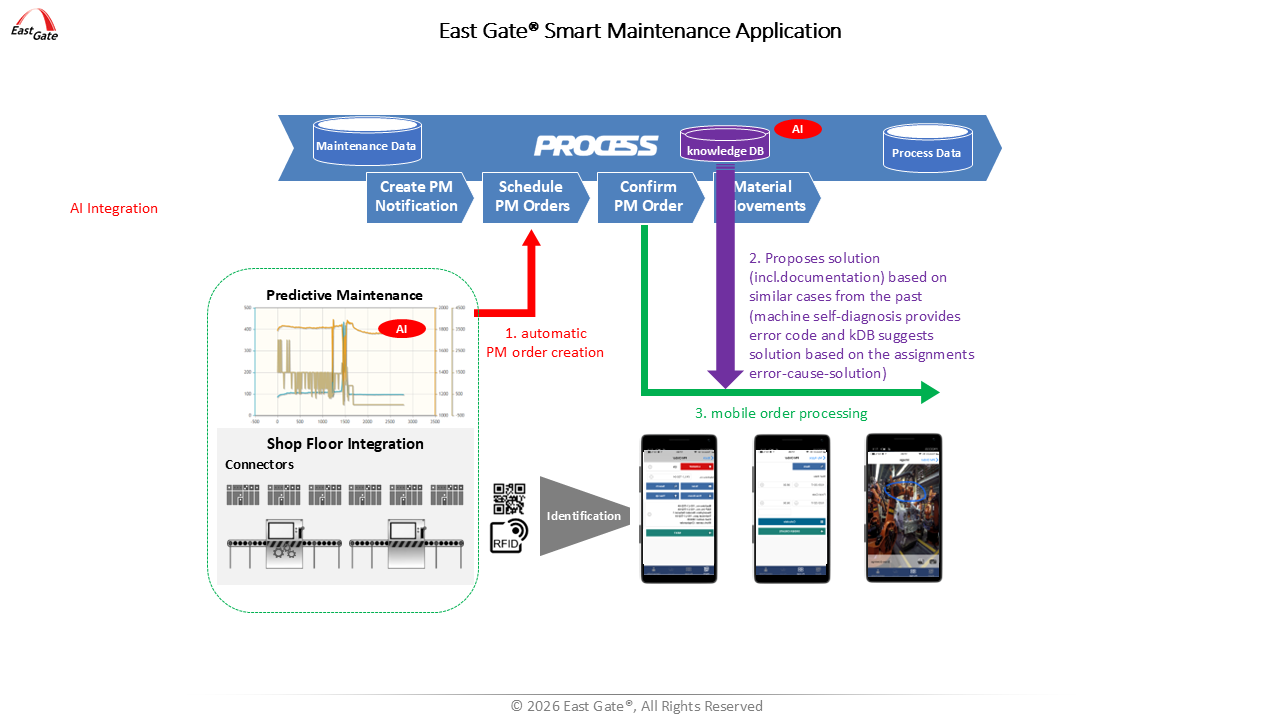
Smart Maintenance combines two seamlessly integrated AI modules: the Plant Maintenance AI Assistant, which helps solve today's problems faster, and Predictive Maintenance, which helps anticipate tomorrow's problems before they affect production.
Artificial Intelligence for maintenance excellence
Maximizing equipment availability requires more than reacting to failures. It demands rapid problem resolution, effective knowledge reuse and the ability to anticipate issues before they impact production.
The East Gate Smart Maintenance solution extends the proven PROCE55® Plant Maintenance application with two complementary AI modules: Plant Maintenance AI Assistant and Predictive Maintenance.
Plant Maintenance AI Assistant
Turning maintenance knowledge into action
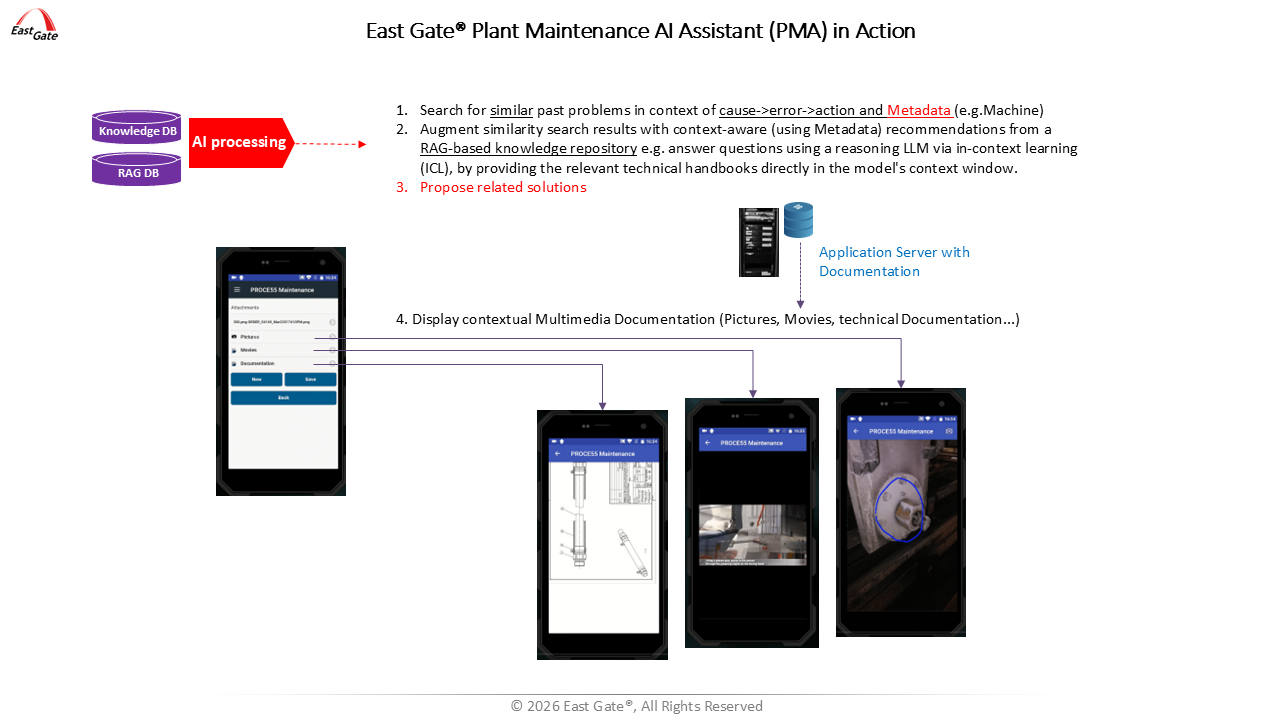
Every manufacturing company possesses a large amount of maintenance knowledge accumulated over many years. Much of this knowledge is hidden in maintenance orders, technician notes, confirmations, service reports and technical documentation.
The East Gate Plant Maintenance AI Assistant transforms these records into an intelligent knowledge base that actively supports maintenance engineers during troubleshooting. Instead of manually searching thousands of records, technicians describe the current problem in natural language.
The AI Assistant searches for similar historical cases, identifies relationships between error, cause and corrective action, and proposes relevant solutions together with supporting technical documentation.
Knowledge-driven maintenance
The system combines maintenance history, confirmations, structured Error-Cause-Action knowledge, manuals, technical documentation, multimedia instructions, machine metadata and contextual production information.
Maintenance personnel receive similar cases, contextual explanations, recommended procedures and supporting documentation within a single interface.
Predictive Maintenance
From machine data to predictive intelligence
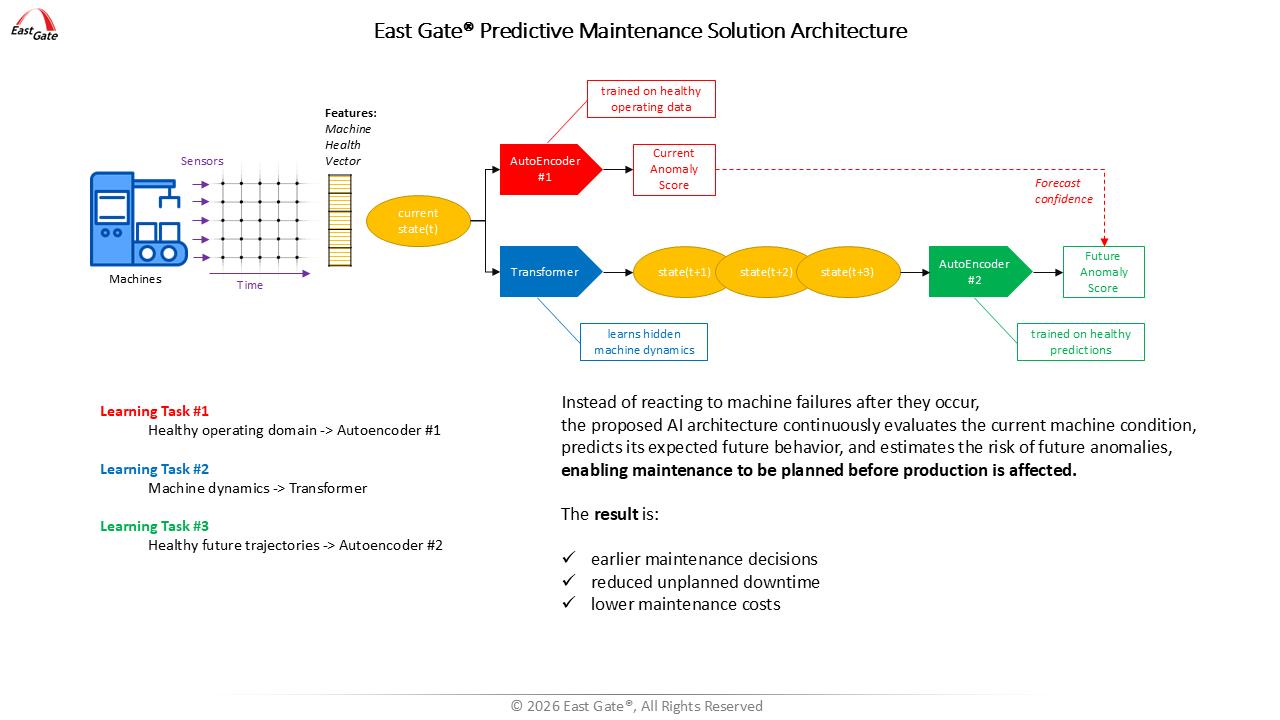
Traditional maintenance reacts to machine failures after they occur. Condition monitoring improves this approach by evaluating current machine health. Predictive Maintenance goes one step further: it asks whether the machine will remain healthy in the near future.
The East Gate Predictive Maintenance solution continuously evaluates current machine condition, predicts future operating behavior and estimates the risk of future anomalies before production is affected.
From data to foresight
Machine sensors generate large volumes of operational data. The Predictive Maintenance solution transforms these measurements into actionable knowledge by aggregating sensor data into temporal features that describe machine behavior over time.
From these features, the system constructs a Machine Health Vector representing the operational condition of the equipment. AI then learns normal operating behavior, machine dynamics and expected future trajectories, enabling detection of subtle degradation patterns before conventional threshold-based monitoring reacts.
Integrated Smart Maintenance
When increasing failure risk is detected, the system can generate maintenance notifications, propose corrective actions based on similar historical cases, present contextual documentation, support scheduling and assist mobile maintenance personnel.